About Me

My photo
Brisbane, Queensland, Australia
See also John Raby's blogs at www.rabylee.uk/linesidingindex.html

Followers

Thursday, June 20, 2013

Poppleton Community Nursery - 19 June 2013

This site is an ex British Rail plant nursery just outside York which is now operated by a community group. A 2ft gauge railway is used to move plants and materials around the site.

A home-built locomotive on a skip frame is named after the builder, Terry Stanhope. A more recent arrival is the Lister LOWECO from the now defunct Abbey Light Railway in Leeds.

No.1 LOWECO

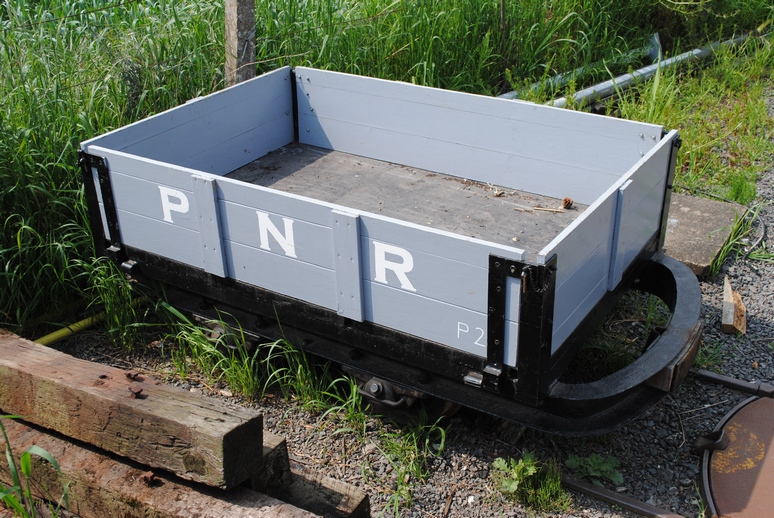
Horticultural flat wagons

A nice drop sided wagon on a skip frame

TERRY STANHOPE loco

National Coal Mining Museum 18 June 2013

The National Coal Mining Museum has been established at the old Capstone Colliery and adjacent Hope Shaft at Overton near Wakefield. One feature of this location is the abysmal standard of signage. Although money has been spent on displays, there are many large exhibits, including locomotives, sitting in the weather, mostly in an unkempt stockyard. There is a working 762mm gauge railway that hauls passengers between the two parts of the site, but it was not in use, and the working locomotives were locked away. There is an exhibition hall that contains some railway items, but it could only be viewed through glass panels. During the school holidays, it may be possible to return to see the train in action and to go inside the exhibition hall.

Standard gauge railways were associated with coal mining from the very beginning, and the National Coal Board operated a large fleet of industrial locomotives. Narrow gauge railways were used extensively on main roadways underground in British collieries, and were also sometimes a feature of surface stockyards for materials and equipment handling.

Hunslet 0-6-0DH of 1973

Robert Stevenson & Hawthorn inside cylindered 0-6-0ST of 1946
An underground GMT B-B DH unit on 2ft 6in gauge


The passenger train stabled at the Hope Shaft station
A Ruston & Hornsby stockyard shunter on display in a workshop


A 1944 Atlas 4wBE on display in the exhibition hall
A recently-arrived 2ft gauge Clayton 4wBE of 1974

Wednesday, June 19, 2013

Restoration workshop - 18 June 2013

Today I visited a workshop where two 2ft gauge locomotives are undergoing restoration. This is a private site associated with an industrial premises, and its location cannot be disclosed publicly.

The first locomotive is a Hudswell Clarke 0-6-0WT built in 1916 and marketed by Robert Hudson. It spent 43 years upside down in a river in Ghana before being salvaged. Its new boiler should be on the frames in the next couple of months.

The cab is ready to be attached once the new boiler is ftted. 

All motion parts have been made from new.
The second is a 1916 Hunslet 4-6-0T that was brought back from Australia by the War Office Locomotive Society. It was used by British Imperial troops in France in World War 1 before undergoing a very hard life at a couple of Queensland sugar mills. This locomotive also needs a new boiler and restoration is continuing as funds permit.
The locomotive has been stripped right down and the frame is being worked on.

The smokebox saddle casting was broken but it has now been expertly repaired.
The return to service of these two locomotives will be a tremendous achivement. Once completed, both are expected to be based at the Apedale Valley Railway.
 

Monday, June 17, 2013

Apedale Valley Light Railway - 16 June 2013

On the other side of Stoke-on Trent is the Apedale Heritage Centre, home of the Moseley Railway Trust. The Heritage Centre was holding a mining gala so it was very busy with lots of families in attendance.

There is a very large collection of industrial internal combustion and battery electric locomotives, and two steam locomotives are currently in operation. It is still an early stage in the development of the facilities on site, but a new line has been built and a station building and museum storage shed have been built.

STANHOPE is a Kerr Stuart ‘Tattoo’ class resurrected from a set of frames cut in two. The second locomotive was built by Kerr Stuart to a Decauville design for the French Army in World War I, known as the ‘Joffre’ class.
STANHOPE at the impressive brick-built Silverdale Station
  
The storage shed is bright and airy, allowing visitors to view the 30 or so locos  inside. This is the prototype Baguley amusement locomotive of 1928, still fitted with its original petrol engine.


This Deutz diesel of 1931 has a single cylinder horizontal engine.


A more modern Hunslet diesel of 1984
The Joffre has a very small space for the crew inside the cab.

The 'Tattoo' class has a much roomier cab and is of a very simple and robust design


Amerton Day 2 - 16 June 2013

A morning return to Amerton gave an opportunity to see the locomotives being prepared and to photograph them running around the circuit of track that provides a run of about a mile.

Preparing locomotives


Simplex on a skip train

ISABEL commenced passenger running for the day

JACK on the skip train

PETER PAN with Graham Morris in typical pose


JENNIE

The splendid Lautoka 19 looks qiuite at home

PADDY

Saturday, June 15, 2013

Amerton Railway - 15 June 2013


A 3¼ hour drive north brought me to Amerton, Staffordshire, home of the Staffordshire Narrow Gauge Railway Ltd. Their line is adjacent to the Amerton working farm tourist attraction, This weekend is their annual gala and their three steam locomotives and three visiting locomotives were in use. There was quite a crowd present and plenty of activity, with locomotives alternating on the passenger train and three freight consists.

Two 'Wren' locomotives were in use as well as a small but powerful gasworks loco. There was also a locally-built vertical boilered locomotive and the newly restored Hudswell Clarke number 19 from Lautoka Mill, Fiji, visiting from Statfold Barn.

Nick Williams' Barclay gasworks loco JACK

Graham Morris' Wren, PETER PAN
Bagnall ISABEL, which initiated the whole Amerton project


Lautoka 19 and ISABEL

A sight to behold, last seen in Fiji


PADDY, a 'bitsa' geared vertical boiler locomotive
 
JENNIE, a new Wren built at Statfold Barn


Carriage shunting with a Ruston LBT
Day 2 of the gala will see a return visit.

Kempton Waterworks Railway - 15 June 2013

The commencement of the 2013 UK narrow gauge program of visits was in west London at Kempton, the site of the Metropolitan Water Board Railway Society's new line at Kempton. The Society hopes to rebuild a section of the old Water Works railway that once ran from Hampton to Kempton to sevice London's water supply system.
The opportunity to have use of the locomotives and rolling stock from the Kew Bridge Museum, out of commission there in 2013, has stimulated the construction of a short line, named the Hanworth Loop, as the first step in the project. The line is laid entirely on concrete sleepers that have been manufactured on site by society members. 

THOMAS WICKSTEED

Although the railway has been operating on Sundays, today was the first steaming day for 2013 of the large pumping engines at Kempton, and there was steady stream of passengers.
The steam locomotive is THOMAS WICKSTEED, a Kerr Stuart 'Wren', construction of which began at Kew Bridge, but completed by Hunslet at Statfold Barn in 2009.

There is also an interesting petrol-hydraulic locomotive named HOUNSLOW, built by one of the volunteers.
HOUNSLOW


Lister Blackstone 44052 of 1958 - 2 ALISTER
Unfortunately, the current setup of the line is not very helpful to photographers but hopefully this will change over time.


Tuesday, April 9, 2013

Tuesday 9 April 2013 - last day in Tasmania

We returned to Hobart from Strahan today to catch our flight back to Brisbane, and took the chance to visit the West Coast Wilderness Railway on our way.


MOUNT LYELL No.1, built in 1896, receiving a very complete polish before starting its day's work


Departing from the station at Queenstown


Mount Owen from the 'Iron Blow', the original Mount Lyell  mine


Mount King William


Penstocks at Tarraleah power station with a disused 2ft gauge incline tramway down its side


Monday 8 April 2013 - Tasmania's west coast Day 2

This was the day we had booked on the West Coast Wilderness Railway which runs between Queenstown and Strahan. It is the rebuilt Mt Lyell Mining & Railway Company's line which includes an Abt rack section. The top section (including the rack) is worked by steam locomotives of Dübs design while the bottom section is worked by diesels of Vulcan/Drewry design. The line is threatened with closure and will be closing this winter season although it is anticipated that it will reopen later in the year.
The line is spectacular in its engineering and its environment.
The presentation of the locomotives, steam and diesel, is second to none anywhere in the world.


MOUNT LYELL No.5, built by North British in 1938


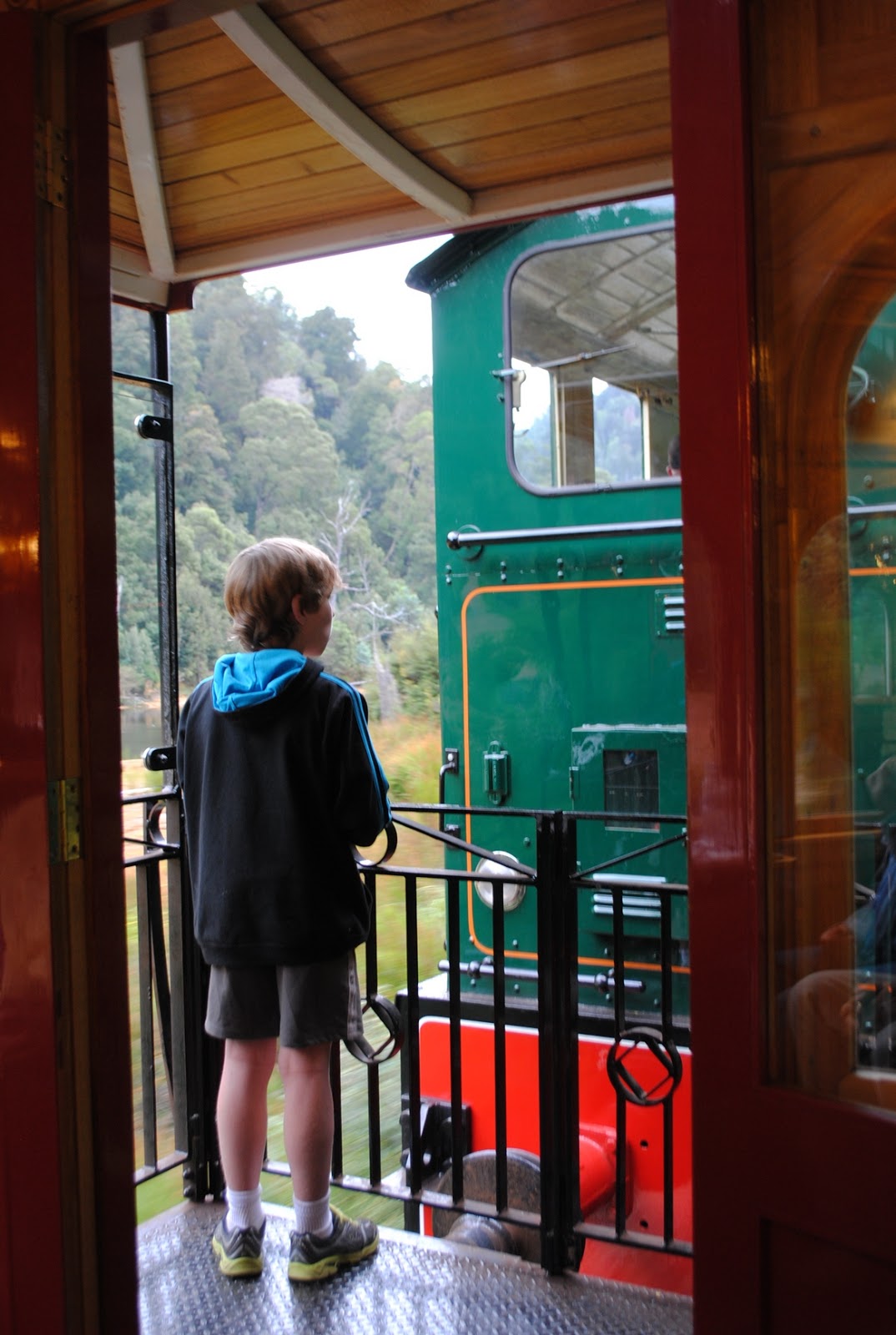
On the rack section through the forest


King River Gorge


The loco is being oiled by its female fireman from the pit at Dubbil Barril but she can't be seen underneath the locomotive
The diesel-hauled train from Strahan arrives at Dubbil Barril


Turning No.5 at Dubbil Barril
. . . and D2, also supplied originally to the Mount Lyell company


D2 at the Lower Landing station with typical west coast vegetation in the background
In the lower King valley


On arrival at Regatta Point, Strahan
At the Queenstown depot, MOUNT LYELL No.3, fitted with Porta-style draughting


Also at Queenstown, ex TGR V9, the first locomotive built at their Launceston Workshops
Regatta Point dusk