About Me

My photo
Brisbane, Queensland, Australia
See also John Raby's blogs at www.rabylee.uk/linesidingindex.html

Followers

Monday, July 16, 2012

PG Purwodadie, PG Soedhono & PG Rejosarie Saturday 14 July 2012

Our substitute hotel in Madiun turned out to be fine in spite of the failures of the booking agency.


Wifi isn’t much good, however.

The Madiun area has six sugar mills and we began by visiting Purwodadie. In spite of his insistence that he knew where it was, the taxi driver took us to Rejosaie where we decided to photograph the O&K locomotive that has been newly displayed outside the gate.


We continued to Purwodadie where two steam locomotives were working cane from the transhipment yard to the mill, across the busy highway and the bridge. There were also two diesels in use, one taking cane to the carrier and another on empties. Future prospects here look quite good with another steam loco serviceable (or close to it) and a fourth having been put back together since 2012.


We then travelled on to Soedhono on a local minibus. Here the steam loco number 1 is serviceable but hasn’t operated for a while. Schoema diesels 3 and 4 were working in the cane yard. On the sugar storage run, Schoema 5 was hauling the trucks from the packing area but the shunting at the sugar shed was being done a by a tractor. Rare Henschel diesel number 1 was on empties.


Remnants of past glories


Henschel diesel


We travelled back to Madiun by airconditioned bus and then took a taxi back to Rejosarie, arriving there at 3.30pm. The two little O&K diesels SLAWI and BROMO were operating at the carrier while Japanese diesel AGUNG was working up at the transloader. The vintage O&K diesel MALABAR was in the shed. The three O&Ks and three of the steam locos have all been painted in a new lighter green livery. The three steamers involved, SLAMET, MERAPI and ARJUNA are all said to be serviceable and available to run if arrangements are made.

ARJUNA


My favourite Java diesel - MALABAR

O and K twins - BROMO . . .


. . . and KAWA


AGUNG in the old livery


We then ordered a taxi to come and pick us up and it took 45 minutes to arrive so we got back to the hotel well after dark.

This was a very successful day.

PG Tasik Madu Friday 13 July 2012

Tasik Madu has a tourist park attached to it and there are plenty of operational steam locomotives that are not used for cane haulage.


On the sugar mill side of things three locomotives are in regular use, a large Orenstein and Koppel Luttermoller steam loco, a Japanese 0-4-0DH and a smaller Schoema diesel.

Roman numerals feature in a number of mill rosters


This always reminds me of a Stanier 8F


The total lineup


This Ruston looks a lot better without the horrible fake boiler bodywork it used to carry


A well patronised train prepares to depart in the tourist park


We travelled from Solo to Madiun by local passenger train consisting of a second-hand Japanese diesel railcar set and after that we observed the branch line train that runs to the Pertamina depot, hauled by a Krupp loco in heritage colours.

Recycled Japanese railcar set on arrival at Madiun


The Madiun petrol train

Friday, July 13, 2012

PG Madukismo and PG Gondang Baru Thursday 12 July 2012

We flew in to Yogjakarta from Bali hoping to meet a new Indonesian friend, Aditya, but he wasn’t there so we went straight to Pabrik Gula (PG or sugar mill) Madukismo. Aditya caught up with us there.  It turns out he lived in Manchester from age 11 to 28.

Maduksimo is a privately-owned mill that was built from scratch by the East Germans and so its entire rail system came as a job lot in 1955 and the locomotives are a rare type built by VEB Karl Marx Babelsburg. There are no field lines, but quite a few locos work in the yard with plenty more in the shed, nearly all complete. A regular mud train is run but we weren’t there at the right time to see it.

This is a very friendly mill, and our guide, Shinta, spoke very good English.

The VEB locos move loris from transhipment yard to the mill


The shed contains plenty of locos in reserve


Stern warnings in the cabs


Some of the loris were built with brakes like this one

The mill mud tramway

Aditya, Shinta and Scott

Maintained with pride


We next visited Gondang Baru, a mill on the way from Yogya to Solo, where we were to stay the night. There are quite a few locomotives, mostly steam, “preserved” here. Only one diesel is in use on cane operations and is used to move empty loris. The shunting of fulls is done by rubber-wheeled tractors. Perhaps the most interesting operation is the 400mm gauge limestone tramway. There are tourist rail operations, with a working steam loco, on a Sunday. 
Linke Hoffmann locomotive

Orenstein and Koppel steamed on Sundays for tourists

The fascinating 400mm gauge limestone tramway

The only locomotive on cane duties

Sectioned at the "museum"


We then travelled on to Solo, otherwise known as Surakarta.
A residential street close to the railway station


Monday, June 25, 2012

Far North Queensland 22 June 2012

Heading straight back to the South Johnstone area, cane was being harvested at Silkwood for Tully Mill and conveyed by road transport to their northern terminus at Atherton Road, a couple of kilometres south of Silkwood township.


The timber bridge at Fisher's Creek on the old Innisfail Tramway has been replaced in steel.


The last Innisfail Tramway locomotive to be supplied, as DL20 PIN GIN, is now South Johnstone Mill number 27 and was noticed heading towards the mill at Wangan with two ballast hoppers and a ballast plough in tow.


Heading back north, further work on the old Babinda line conecting to Mulgrave Mill was going on at Cucania, with the loops there being relaid.
The ballast is not blue metal but quarry fines.


Further ahead, another locomotive new to Mulgrave, Clyde 23 BEHANA, was heading towards the mill in the Aloomba area.

This 1955-built locomotive has previously operated at Hambledon, Goondi, Babinda and South Johnstone Mills. 


Back at Mulgrave, another Clyde locomotive, 16 KAMMA, is in desperate need of a repaint, in spite of the new engine cover it received recently. 'Hambledon Mill 6' is clearly visible on the cab side, and Hambledon Mill closed 21 years ago.


Another ex-Hambledon Mill locomotive at Mulgrave is EM Baldwin 11 MAITLAND. It looks very smart in its new coat of paint.

Far North Queensland 21 June 2012

With the start of the season having commenced, a further trip "up north" provided some opportunity to view a few cane trains in action.

Mulgrave Mill was having a maintenenance shift on the morning I arrived so there was an opportunity to view the unloading station engineered by the late Harvey Flanders.

Cane comes in on the right hand side line to be tipped and then is taken to the empty line on the left by a traverser. The two modified bins are for the spilt cane billets that are cleared away. 


In 2012 Mulgrave Mill is crushing all cane from Babinda northwards and has obtained some additional locomotives out of those previously stationed at Babinda and South Johnstone. The state of the former Babinda Mill track from Babinda to McDonnell Creek will not allow for the use of bogie locomotives on this run as yet.

South Johnstone Mill number 22 has become Mulgrave Mill's  26 MERINGA.


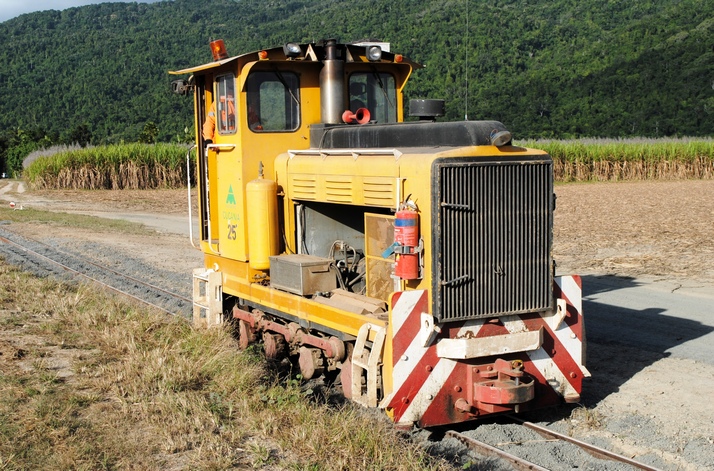
South Johnstone Mill's number 20 has become Mulgrave's 25 CUCANIA. This was formerly Moreton Mill's MORETON, seen here waiting for cane at Bundy Loop, McDonnell Creek.


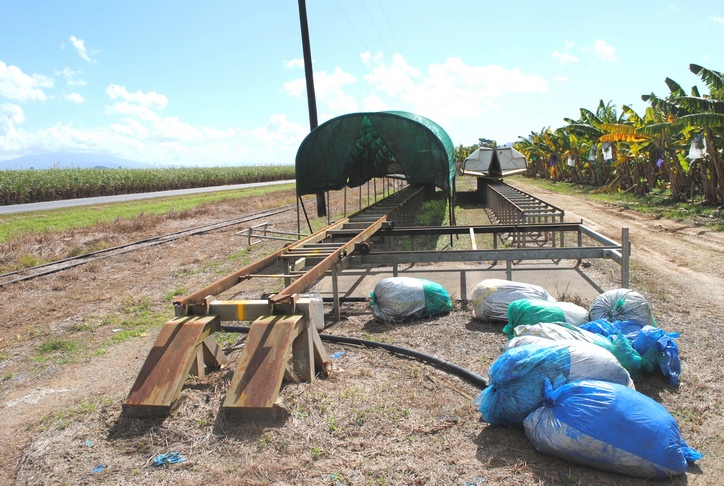
The local banana industry has picked up some ideas of 2ft gauge railroading. Here is an example of a commonly used technology locally. There is a shaded full line on the left and an empty line on the right, connected by a traverser. Four-wheel rail vehicles are rolled off onto a rubber tyred vehicle upon which the picked fruit is placed. On return to this holding siding, the fruit-laden rail vehicles are placed in the shaded section awaiting pick up by the road vehicle that will take them to the packing plant. This way the bananas are potected from bruising and sunburn.
Banana siding. The rails are just flat steel bars.


With the inclusion of the Mulgrave Mill tramway in the South Johnstone system, the main line from the former Mourilyan area crosses the QR North Coast Line at Ramleh. Here Clyde number 18 comes through the catchpoints with a loaded rake.
This locomotive was formerly Mourilyan Mill number 2.


Sugar boxes were once used to convey raw sugar to Mourilyan Harbour but have not been seeen in the district for a while. However, these two examples from the Herbert River district were spotted outside the Bradken engineering works at Boogan.
These Sucrogen bulk sugar boxes are sitting on the old Mourilyan Mill line outside what was once Camuglia's engineering works.


Heading further south, South Johnstone Mill's number 38 was found alongside Utchee Creek Road. This locomotive is based south of the large 'Silver Bridge' over the South Johnstone River which locomotives are now no longer allowed to cross, so when it rachers the bridge it pushes its load ahead of it to be picked up by another locomotive on the mill side.


One of the old 'canetainer' wagons that was used in association with long-distance road transport at South Johnstone Mill was noted in use at Formosa Road. Most of these vehicles are stored out of service at the Goondi Mill site.


Not much time left in the day by the time Tully was reached. Here is rebuilt 3ft 6in gauge TULLY-9 with plenty of glass in the rear cab wall, heading north with empties.


Saturday, June 9, 2012

More on 'Built by Bundaberg Foundry'

I finally have retail sales details for the new book.

It is available from the publisher for $22.50.

For postage & packing add $4.75 in Australia; $11.15 for New Zealand; and $15.80 for other overseas addresses.

Credit card facilities are available.

Payment must be made in Australian currency.


If you would like an order form, please email me at ceo8@iinet.net.au and I'll send you one.


Here is a blurb:


THE AUSTRALIAN NARROW GAUGE RAILWAY MUSEUM SOCIETY

is proud to announce the publication of its new book

BUILT BY BUNDABERG FOUNDRY

by John Browning & Brian Webber

Using manufacturer’s records and the memories of those who built them and worked on them, this book tells the story of the steam and diesel locomotives produced by this famous Queensland company. Narrow gauge locomotive manufacture began after the Second World War. Bundaberg Fowler steam locomotives were used to haul sugar cane, and Bundaberg Jenbach diesel locomotives were supplied to the sugar and coal mining industries. 35 years later, the Hunslet Engine Company assisted the Foundry to produce new powerful canefield diesels. Subsequently, many ex-government railway locomotives were converted for cane haulage. Many of the steam locomotives are well known because of their use on Australian tourist and heritage railways.

 The 80-page A4 book is printed on high quality art paper and contains more than 160 photographs, most of them in colour, as well as a number of drawings and diagrams.